


Pottery fit for a Roman table

Updated: Jul 25
Ancient Roman potters did not develop a vase-painting tradition equivalent to the Greeks and Etruscans. Nor did the Romans routinely bury pottery as grave goods. Roman pottery vessels were utilitarian, ubiquitous and inevitably evolved with historical, economic, geographic and cultural factors. Indicative of Roman industry, trade and everyday culture, Roman domestic pottery vessels can be broadly categorised as coarse wares and fine wares. We will take a "potted" look at a few types of fine ware that would have graced a Roman table, and which may be of interest to collectors of antiquities.

What is Ancient Roman pottery?
Ancient Roman pottery can encompass all pottery made within the bounds and reach of the Roman Republic and subsequent Empire, as far as the provinces of Egypt and Palestine. Late Roman can also include pottery traditions extending well beyond the fall of the Empire into the "Migration Period" and Byzantine era. Here we look briefly at a few characteristically Roman types that may be of interest to collectors. Oil lamps, architectural and sculptural pottery tend to be classified separately for the purposes of collecting.
Coarse wares
Coarse wares are earthenware vessels used for food preparation, storage and transportation.
The mortarium, for example, was a distinctly Roman coarse ware vessel. Used in food preparation, it was rather like the mortar of a modern "pestle and mortar" pairing, but with a lip. (See https://www.britishmuseum.org/collection/object/H_1973-0702-16)
Amphorae, which type of container had been widely used since neolithic times, were large unglazed coarse wares and the standard way to transport and store many commodities in the Classical world, such as olive oil.
Ede (1976, p38) suggests that, while the output of Roman Empire coarse wares must have been huge, their lack of decorative qualities means that, generally speaking, they are of little interest to collectors.
See https://potsherd.net/atlas/Class/COAR for further information on Roman coarse wares.
Fine wares
While coarse wares would have had multiple functions as everyday pottery, fine ware is the term covering Roman pottery tableware as used in more formal dining.
Bronze, silver and glass were also used as tableware materials. Silver service became abundant from early 2nd century BCE, and blown glass vessels were widespread as luxury products from mid 1st century BCE. For a detailed and fascinating look at the Roman dining experience see Matthews, 1969.
We will highlight just a few types of fine ware here. For further information see https://potsherd.net/atlas/Class/FINE.
Black-gloss ware
Providing a backdrop to the development of later fine wares, the predominant tableware pottery of the Roman Republican period from 4th to 1st century BCE was a black slipped and burnished pottery known as Black-gloss or Campanian ware, which imitated its metal equivalents providing a cheaper alternative, and was manufactured in central and southern Italy.
Black-gloss ware's development echoed the interplay of Roman and other Italian cultures, along with Greek and contemporary Hellenistic influences. Di Giuseppe (2012, p xv) states that this ware developed from both later Attic and local pottery traditions, and gives as an example Etruscan bucchero and cream ware, whose forms were taken up and developed by Black-gloss ware.
Close study of these types of ceramic and their context can provide insight into the development of Roman identity and expansion during the Republican period.
(See: Banducci, 2014 & Di Giuseppe, 2012)
Lead-glazed ware
Lead-glazed was a technique long-established in the Near East, which made its way to the Romans during the 1st century BCE, and was commonly found as the scyphus or drinking cup. Decoration was typically moulded in relief, imitating metal-work repousée, as was often the case in Antiquity. (Ede, 1976)

Terra nigra ware
Ede (1976, p38) describes Terra nigra as, 'a Gallo-Belgic black ware, mainly from the Rhineland. It copies the forms of red-gloss ware and the decoration is mainly incised or rouletted.'
Terra nigra tableware was used across north-eastern Gaul and south-eastern Britain from the late 1st century BCE.

Nene Valley or Castor ware
Romano-British Nene Valley Ware or Castor Ware, probably introduced from Germany and often in the form of beakers, was at its height during the 3rd century CE. It was distinctive for its decoration, often with trailed or piped barbotine. (Ede, 1976 p38).
Among the local fabrics of Britain under Roman domination, that usually known as Castor ware holds the pre-eminence. It is, in fact, the only one that can lay any claim to artistic merit.
H B Walters, 1908, British Museum London, Catalogue of the Roman Pottery in The Departments of Antiquities, British Museum, Introduction pl, para 2.

For further information see https://www.nenevalleyarchaeology.co.uk/colour-coated-ware
Terra sigillata (red-gloss wares)
Red-gloss wares is the umbrella term favoured by Ede (1976) for the fine ware pottery familiar to many for its bright red and glossy surface, which appeared in the 1st century BCE. For this pottery tradition, unbroken across its various forms and centres of manufacture for seven centuries, here we will use the archaeological term "terra sigillata".
In the history of archaeological studies, the terra sigillata class firstly included moulded vessels with relief decorations, typically characterized by a shining, bright red, glossy coating. Over time, however, the denomination has started to include plain vessels made on the wheel, similarly characterized by red coatings, with variable tones and brilliance. Other names such as “Arretine ware”, “Samian ware” (i.e. Gaulish terra sigillata), “sigillata made in the Italian manner” or “African red-slip ware” (in English) and Glanzton (gloss, in German) are also used to indicate specific production centres or characteristics but without ever renouncing the common denomination of terra sigillata.
Gliozzo, E. (2020). Ceramic technology: How to characterize terra sigillata ware. Archaeological and Anthropological Sciences, 12(9), p211 para6
Terra sigillata has been extensively researched and classified. It provides oportunities to examine the spread of Romanisation, trading and cultural practices as well as forms, decorative themes, workshops, potters' stamps and variations in manufacture and quality.
The frequency of potters' stamps and varieties in style are particularly helpful in dating accompanying archaeological material. (Britannica Editors, 2011. Accessed 7 Jan 2026).
Arretine ware
Towards the end of the Roman Republican period, in the second half of the 1st century BCE, the first and largest production centre of terra sigillata was at Arretium (modern Arezzo) within ancient Etruria. The red-gloss tradition was already established in the East, and Arretine vessels were inspired variously and arguably by Eastern Sigillata A and Pergamene relief ware (common red slipped pottery from the Near East), Hellenistic relief pottery Megarian ware, repousée decorated metal vessels and the affore-mentioned Italian Black-gloss ware. (Gliozzo, 2020 p210-1 & Hayes, 1972 p8).
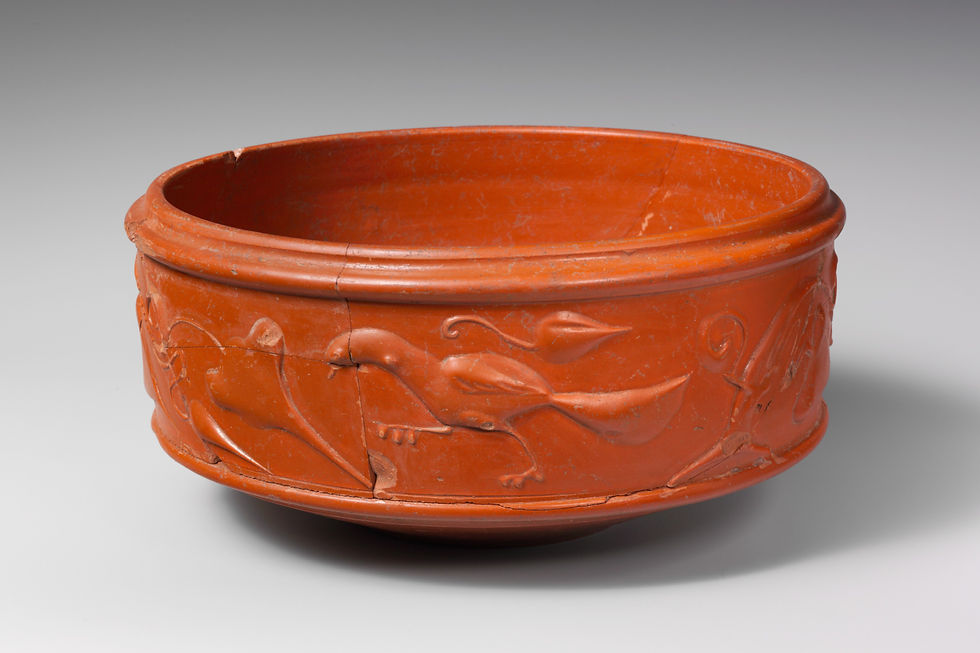
The red colour was achieved as per the already well-established Greek and Etruscan method (Ede, 1976 p37). High quality plain vessels were the most numerous. Low-relief decorated vessels were made from moulds stamped with dies of patterns, plant forms and figurative scenes of Helenistic, mythological and epic themes, prioritised by popular demand (Poblome, 2013). Some forms, particularly later, were decorated with barbotine (a form of slip-trailing) and appliqué.
Arretine maker or potter stamps, which include slave and former-slave names, were regularly applied, along with occasional graffiti. Study of sigillata stamps is a specialised field. (Martin, 2016, p296)
Arrentine ware, with its new features, became the market leader in the Mediterranean and the fine pottery model, even influencing old-established centres of production, for example in vessel forms (Hayes, 1972, p9).

Production spread to other workshops around Italy, peaking around the beginning of the 1st century CE. Italian terra sigillata was distributed widely across the Mediterranean, the eastern provinces, Gaul and southern Britain. (https://potsherd.net/atlas/Ware/ITTS Accessed 7 January 2026). The Pax Romana, the golden age of the Roman Empire, can only have aided mass production and wide distribution.

Italian producion began to decline from mid 2nd century CE giving way to Gaulish and then African sigillata (Gliozzo, 2020 p 210).
Samian (Gaulish) ware
Gaulish sigillata is sometimes known by the apparent misnomer Samian ware, particularly in the UK and among English-speakers. It was imported into Britain on a vast scale during the Roman period (Hartley, 1970).
During the time of Emperor Augustus, production of terra sigillata began in southern Gaul (predominant in the 1st century CE) and subsequently central and eastern Gaul (predominant in 2nd-3rd centuries CE). Under Gaulish influence, Spain also produced sigillata for its home market, continuing until 4th century CE. (Hayes, 1972 p11.) There were even workshops briefly in southern Britain. (Hartley, 1970 p239).
Southern Gaulish potters developed their own style with brilliant red-gloss vessels. They were mostly free craftsmen (Martin, 2016 p304). During the height of production, this was the dominant decorated ware in the North West, along with exports across the Empire.
(North) African red slip ware (ARS)
Arretine ware had influenced pottery styles all over the Roman Empire, but while the North moved to central and eastern Gaulish ware, from the end of the 1st century CE the Mediterranean saw the final phase in the evolution of terra sigillata begin in the Roman provinces of modern Tunisia and eastern Algeria. This North African tradition, which in English is called African red slip ware, carried on for over 500 years until the Arab invasions of the 7th century CE, well beyond the fall of the Roman Empire. Hayes (1972 p13) states it was the leading fine ware in the Mediterranean, even in Rome itself, and appears to have dictated pottery trends throughout the region for much of this time.
The clay is coarser, lighter in colour and not as glossy as its Italian and Gaulish forerunners. The influence of European predecessors gradually waned and vessels were produced in standardised types, which were superseded by new ones rather than modified, helping with classification. Most vessels were plain or decorated with grooves and rouletting (rolling an engraved tool across the clay to create a pattern). Where there is relief decoration, it is restrained, stamped, incised or modelled in relief. (Hayes, 1972 p13-14)

Grooved handle African red-slip ware jug; c. 2nd to 4th century CE; TimesAncient 
Typical rouletting decoration of African red-slip ware; c. 2nd to 4th century CE; TimesAncient 
African red slip ware jug; c. 2nd to 4th century CE; TimesAncient
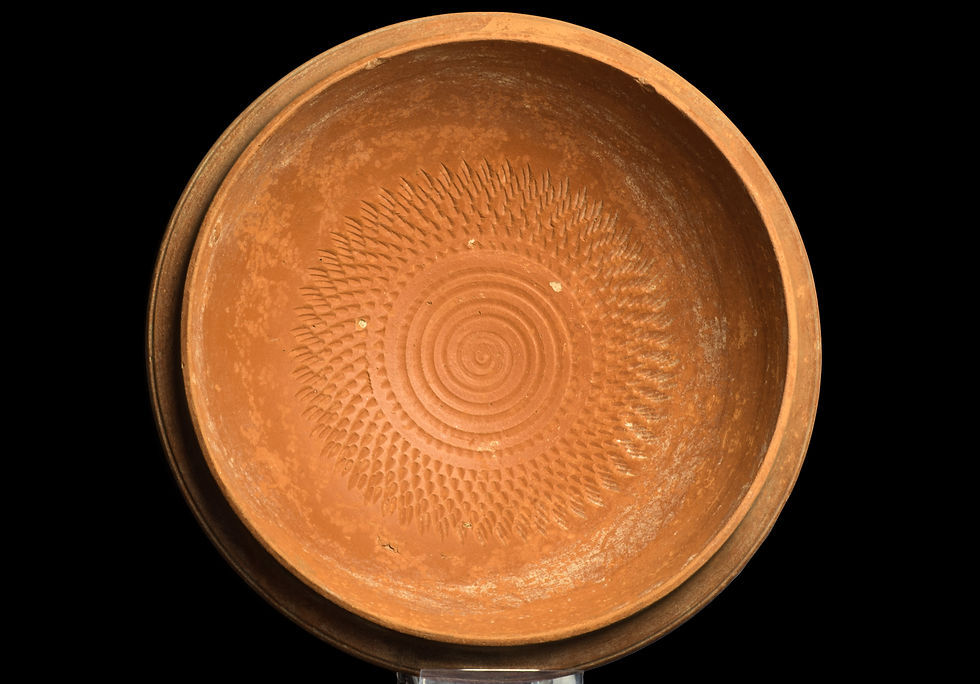
A development of the [rouletting] technique characteristic of the African wares is the covering of broad surfaces with row upon row of overlapping rouletting, in such a manner that the individual strokes appear to the eye to be arranged in vertical or radiating chains, an effect aptly described by various writers as 'feather-rouletting'. This effect seems to have been deliberately exploited.
Hayes, J.W. (1972) Late Roman Pottery. The British School at Rome, London, p14, para4
Hayes (1972) p282 suggests that feather-rouletting tries to reproduce fluting decoration, often curved, on Roman silverware and cites for comparison the silver flanged bowl no. 12 from the Mildenhall Treasure, as pictured at https://mildenhallmuseum.co.uk/collections/treasure/ Accessed 11 January 2026 and at the British Museum no. 1946,1007,10. The pottery bowl pictured below is an example of this comparison.
Hayes (1972, p14) states that many of the later examples of African red slip ware bear stamped decoration on the floor, in what he calls the manner of a large medallion. This again points to the influence of contemporary metalware.

African red slip ware plate with medallion decoration; 4th to 6th century CE; TimesAncient 
Stamped decoration; c 4th to 6th century CE; TimesAncient
African red slip ware dish with palm branches; late 4th to early 5th century Palm branch, rouletting and groove decoration
In later African wares, Christian motifs and figurative scenes were sometimes present, such as chi-rho and cross monograms (Hayes, 1972 & van den Hoek, 2006).
Types of jugs and flagons represent "closed" forms - often simple, plain or minimally decorated. Note the distinctive shape of the lagynos (for pouring wine) in the middle image below, and the subtle herringbone decoration on the handle of the right-hand image below.
African red slip ware flagon; c. 3rd century CE African red slip lagynos; 1st to 2nd century CE African red slip ware flagon; c 250 to 300 CE;
Closing remarks
While less decorative and with apparently less artistic merit than the pottery of the Greeks and Etruscans, Ancient Roman pottery can nevertheless be appreciated for its craftsmanship, specialised forms and often just its simplicity. Indicators of organised industry, networks, cultural exchange and popular trends across the vast geographical and temporal realm of Roman influence, these vessels deserve a place in the cabinet of the collector of antiquities.
Bibilography, references and further information
Banducci, L. (2014). Ceramics: Roman Republican and Early Principate. From Smith, C. (eds) Encyclopedia of Global Archaeology 1st ed. Springer, New York, NY. ISBN: 9781441904669
Banducci, L., & Mogetta, M. (2016) [2017] Roman Black-Gloss Pottery from the Capitoline Museums at the University of Missouri: A New 3D Scanning Project for Use Wear Analysis, Muse 50, pp. 33-44.
Britannica Editors (2011, March 24). terra sigillata ware. Encyclopedia Britannica. https://www.britannica.com/art/terra-sigillata-ware
Dannell, G.B. (2018) The Uses of South Gaulish Terra Sigillata on the Roman Table. A study of nomenclature and vessel function, Internet Archaeology 50. https://doi.org/10.11141/ia.50.5
Di Giuseppe, H. (2012), Black-Gloss Ware in Italy: Production management and local histories, BAR International Series 2335, Archaeopress. ISBN: 9781407309187
Ede, C. (1976), Collecting Antiquities: An Introductory Guide, J.M. Dent & Sons Ltd, London
Gliozzo, E. (2020). Ceramic technology: How to characterize terra sigillata ware. Archaeological and Anthropological Sciences, 12(9), 211.
Greene, K. (2023, May 24). pottery, Roman. Oxford Classical Dictionary. Retrieved 11 Jan. 2026, from https://oxfordre.com/classics/view/10.1093/acrefore/9780199381135.001.0001/acrefore-9780199381135-e-5293.
Hartley, B.R., (1970), Roman Samian Ware (Terra Sigillata), Hertforshire Archaeological Society (HAS) Print No.1
Hayes, J.W. (1972) Late Roman Pottery. The British School at Rome, London
Hunt Museum Limerick online collection. Accessed 13 January 2026. https://www.huntmuseum.com/explore/item/5b3ad5a0-1daf-33f0-8ab2-fac089f7daff/?s%3Dhare&pos=1
Kenrick, P. (2013) Extract: Roman Mediterranean: Stamping Ground, World Archaeology Issue 58. Accessed 13 January 2026
Martin, A. (2016). Terra Sigillata and Related Wares. Bonfante, Larissa and Helen Nagy (with the Collaboration of Jacquelyn Collins-Clinton), The Collection of Antiquities of the American Academy in Rome, Memoirs of the American Academy in Rome, Supplementary Volume XI. ISBN: 9780472119899
Matthews, K.D. (1969) Scutella, Patella, Paterna, Patina. Expedition Magazine 11, no. 4 (July, 1969). Accessed January 11, 2026. https://www.penn.museum/sites/expedition/scutella-patella-paterna-patina/
https://mildenhallmuseum.co.uk/collections/treasure/ Accessed 11 January 2026
https://www.nenevalleyarchaeology.co.uk/colour-coated-ware Accessed 11 January 2026
Poblome, J. et al. (2012). Pottery, Roman Empire. In Roger Bagnall, Kai Brodersen, Craig Champion, Andrew Erskine and Sabine Huebner, Eds. Encyclopedia of Ancient History, Wiley-Blackwell Publishing. ISBN: 9781444338386
Poblome, J. (2013) Money makes pottery go round. From Exempli Gratia Sagalassos, Marc Waelkens and Interdisciplinary Archaeology; Leuven University Press. ISBN: 9789058679796
Teixeira-Bastos, M. (2018). Emerging Distribution Networks of Roman Pottery in the Ancient Mediterranean: The Sigillata Clay Lamps of Proconsular Africa. From Heródoto - UNIFESP (Federal University of São Paulo), 3(2), 132–157
van den Hoek, A. (2006). Peter, Paul and a Consul: Recent Discoveries in African Red Slip Ware. ZAC, Vol. 9, Pp. 197-246.
Walters H.B. (1908), Catalogue of the Roman Pottery in the Departments of Antiquities, British Museum. British Museum, London

Comments