


Pre-Columbian Mesoamerican art - the human focus

Updated: Mar 3
Pre-Columbian or pre-Hispanic Mesoamericans may not have worked iron or used the wheel, but these diverse peoples developed complex civilisations and cultures with all the associated high achievements, including in art, from the monumental to the miniature. One of the common features of Mesoamerican art is a focus on the human experience and image. With this in mind, we dip our toes into the Preclassic and Classic periods of this vast, rich and varied group of cultures to look at a few types of figurine, which can be highly attractive to the discerning collector, often at affordable prices.

The context
Timeline (selected and variable)

The Archaic period covers the long transition from Paleao-Indian or Lithic hunter-gathering to plant domestication, sedentism and the proliferation of agricultural settlements.
The Preclassic or Formative Period saw the gradual development of impressive ceremonial centres, social stratification, early calendars and writing systems, early pyramid-building and the ceremonial rubber ballgame. The dominant civilisation was Olmec. Olmec culture, sometimes called the "mother culture", was widely diffused and brought about a Mesoamerican cultural area. On the western periphery, early ceramic-producing cultures such as Capacha and El Opeño developed separately (Ryan (ed), 1992, p264).
Characteristics of the Classic Period include: division into many regions; flourishing city-states; colossal pyramid-temples; sophisticated calendars; mathematical, writing and astronomical systems; textile weaving, mural painting and a great quantity and variety of art styles (Pasztory, 1998, p75). The principal civilisations were Teotihuacán, a densely populated city and temple complex, and Maya, a network of city-states. The village cultures of West Mexico however remained largely outside their sphere of influence until circa 600 CE (Ryan (ed), 1992, p257).
The Post-Classic is the term used for the Period following the collapse (for unknown reasons) of Classic civilisations with increased conflict in the region. There were advancements in technology, particularly metalworking, increased migration and population, small city-states then empires, which eventually came to be dominated by the Mexica, the Aztec ethnic group (Evans, 2008, p428). Art and architecture was less prolific, less complex and an overall Postclassic style developed known as Mixteca-Puebla style (Pasztory, 1998, p76)
Locations (selected and variable)
Mesoamerica is an archaeological or cultural term for the region that comprises the southern half of present-day Mexico, eastwards to Nicaragua and Costa Rica, from Pacific to Gulf to Caribbean, encompassing a highly varied geography.

Commonalities
Despite variety across Mesoamerican peoples, time and place, there are commonalities to be found: ceremonial centres; pyramid-building; monumental sculpture; the 52 year calendar and a belief in the cosmic order; sacrifice; "the ballgame"; astronomical, mathematics and glyphic writing systems; domesticated plants such as the staples of maize, amaranth, beans and squash (Townsend,1992, p117). West Mexican village cultures apparently remained outside of the more spectacular of these characteristics until circa 600 CE (Ryan (ed), 1992, p257), but nevertheless participated in "the ballgame" and developed rich ceramic and tomb traditions.
In contrast to the Andes, human representations and narratives abound in all Mesoamerican archaeological sites, establishing an instant bond with the modern viewer. 'The art of Mesoamerica seems to deal with the world of people ...' (Pasztory, 2008, p16, para.1)
The human focus in Mesoamerican art
If you look in any museum or any book on Mesoamerica, or at any site, you will find faces staring at you, people engaged in various activities or enacting mysterious rituals.
Pasztory, Esther, Pre-Columbian Art, Weidenfeld & Nicolson, 1998, p15, para.3
Olmec colossal head, San Lorenzo c 1200-900 BCE 
Olmec style baby figure, c 1200-800 BCE, Met Museum NY 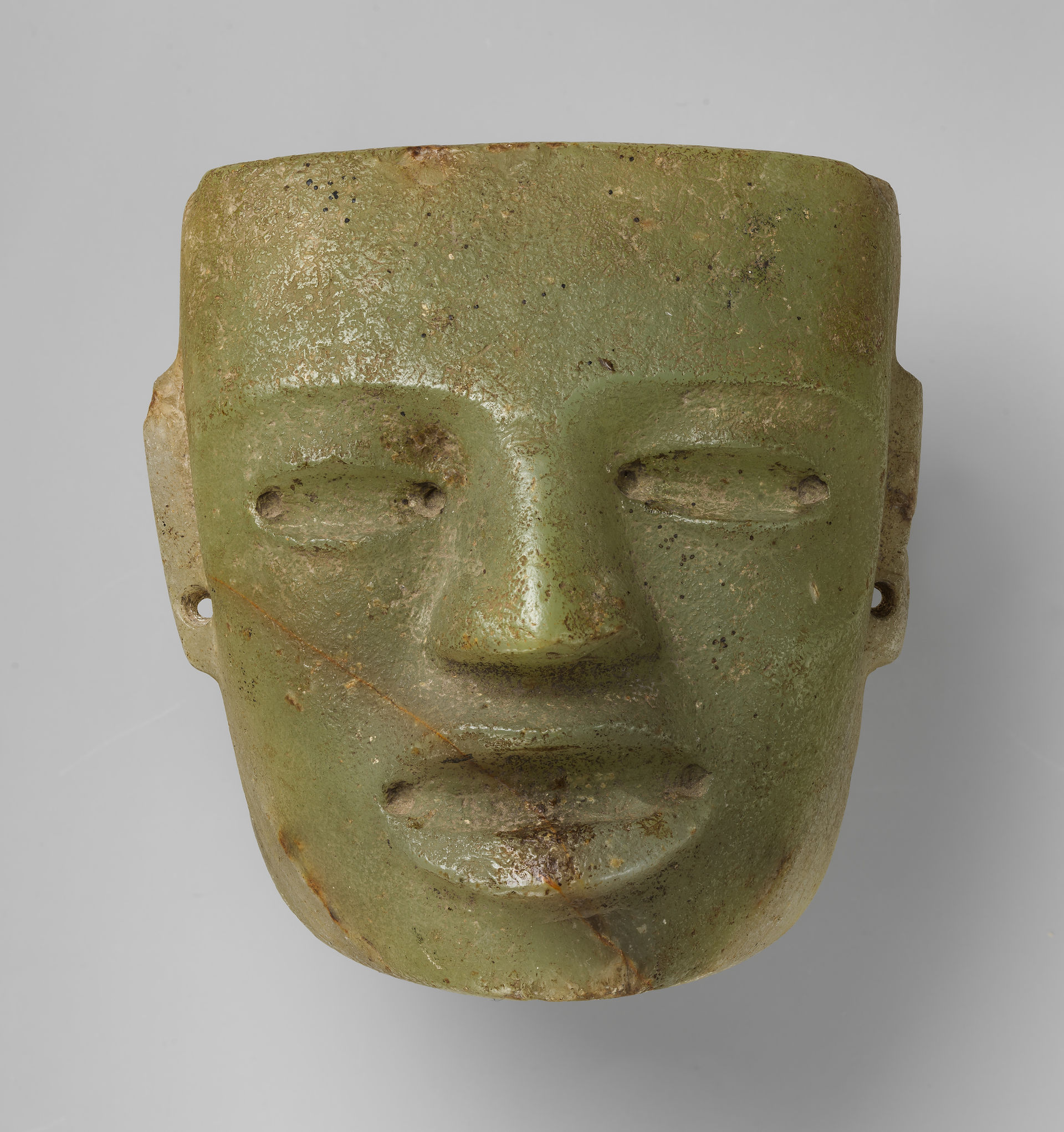
Teotihuacan stone mask, 300-600 BCE, Met Museum NY 
Maya whistle of maize god, 300-600 CE, Met Museum NY 
Zapotec effigy funerary urn, 350-600 CE, Met Museum NY 
Classic Veracruz bowl with ballgame scenes, 500-900 CE, Met Museum NY
Clockwise from top left:
Olmec colossal head, San Lorenzo Tenochtitlán, c 1200- 900 BCE; image by Utilisateur; Wikipedia license
It is argued in Townsend et al (1992, p121&133) that Olmec sculpture is essentially centered on the human form and that monumental sculptures such as these giant heads used a system of geometric, harmonic proportion that reflected their particular vision of an ordered natural world.
Olmec style baby figure, Las Bocas artist, c 1200-800 BCE; Met Museum NY
For further reading on Olmec baby figures see Olmec Babies as Early Portraiture in the Americas
Teotihuacán geometric stone mask, 300-600 CE, Met Museum NY
Teotihuacán was a huge, densely populated city and ceremonial complex laid out in severe geometric style on an astronomically-aligned grid system, similarly 'Flatness, angularity, and geometric abstraction characterize the art of Teotihuacán' (Pasztory, 1998, p.69, para.1). 'With the preeminence of masks or masklike faces, Teotihuacán art is the opposite of the humanist art of the Olmec and the Maya ...' (Pasztory, 1998, p72, para.4).
Maya whistle with maize god with idealised facial features emerging from a flower, 600-900 CE, Met Museum NY
Zapotec effigy funerary urn, 350-600 CE, Met Museum NY
The Zapotecs are particularly known for their elaborate funerary urns - hollow cylinders, overlaid with luted strips and modelled clay sheets in full relief, generally depicting gods and goddesses of human appearance or ancestors. While the ornamentation varies so that each urn is highly individual, the human figure, almost always seated, remains rigid. (Burland, 1976, p53 & Ryan (ed) 1992 p9).
Classic Veracruz lidded bowl with ballgame scenes, Rio Blanco artist, 500-900 CE, Met Museum NY
For more information see The Mesoamerican Ballgame.
Focus on figurines
... figurines are among the most abundant class of artifacts known in the vast Mesoamerican culture.
Halperin, Christina T, et al, SUMMARY: Mesoamerican Figurines: Small-Scale Indices of Large-Scale Social Phenomena, University Press of Florida, 2009, para.2
Easby et al (1970 p47) describes the spread of little clay figures from circa 1500 BCE as the beginning of a "figurine cult" that spread throughout Middle America.
Divisible into numerous types and subtypes, the figurines have yielded more information about ancient life than other excavated ceramics, partly because their liveliness and charm, as well as their many classifiable differences, make them impossible to ignore.
Easby, E.K. et al, Before Cortés, Sculpture of Middle America, The Museum of Metropolitan Art, 1970, p47, para.1
Mesoamericans produced stone, ceramic and wooden figurines in an array of styles.
Here we focus on just a few types in the human image, some of which are relatively available to the modern collector.
Nude females and "pretty ladies"
Early Preclassic small terracotta figurines were predominantly representations of nude females, which 'suggests the existence of a fertility cult linked to the concept of "mother earth".' (Ryan (ed), 1992, p5, para.7). These diversified locally to include adornments and stylised shapes, particularly in the case of "pretty ladies".
Village cultures, such as Tlatilco in the Valley of Mexico in the Central Highlands, came under Olmec influence during what is termed the Manantial phase (1000 to 800 BCE) of the Preclassic Period, from which emerged particular styles of pottery including figurines such as "baby-face" and "pretty ladies" (Ryan (ed), 1992, p20).
The name, given as a joke, has stuck to them because they are indeed pretty ladies with elaborate coiffure and plentiful jewellery but not a trace of clothing. Probably they are representations akin to the Corn Maidens who play such a big part in Pueblo Indian belief.
Burland, C A, Art and Life in Ancient Mexico, Bruno Cassirer Oxford, 1948, p78, para.2

Tlatilco female figure "pretty lady"; 12th-9th century BCE; Met Museum NY 
Tlatilco female figure "pretty lady"; 10th century BCE; Met Museum NY
Depicting females with large heads, small waists, and prominent hips, these handheld sculptures present a fairly standardized body type and are typically fired to red, buff, or brown tones. As the popular embodiments of an ideal feminine form, the Tlatilco "pretty ladies" are part of a centuries-long tradition in which eccentricities and religious imagery predominate. Featuring hunchbacks, dwarfs, contorted acrobats, two-headed women, and conjoined twins, the corpus of Tlatilco figurines encompasses the full gamut of human representation.
Other distinctive and stylized nude female figures, in keeping with the old "fertility cult" tradition, were produced in Michoacán and in the Chupícuaro culture of the Late Preclassical Period. These are also sometimes referred to as "pretty lady" types, though they are different to those of Tlatilco. Although close to the Valley of Mexico and possibly trading there, Chupícuaro is sometimes bracketed with West Mexican cultures. It was a large pottery centre with extensive cultural influence, which preserved the art of ceramic sculpture once its first peak of excellence had declined in Central Mexico after the Middle Preclassic (Easby et al, 1970 p52, para.2).

Classic Veracruz - "the ballgame", "smiling faces" and a "dirt eater"
Within the Gulf Coast grouping known as Classic Veracruz Culture, the city of El Tajín became important following the demise of Teotihuacán in the Late Classic Period. It is argued variously that it was settled by the Totonacs or the Huaxtecs (an early Mayan speaking group). It had over a dozen ball courts. The ceremonial ballgame forms one of Mesoamerica's defining traits, with possible origins in the Archaic (Evans, 2008, p92). Stone sculptures originating from Veracruz include "jugos" (yokes worn as a belt), "palmas" (palms) and "hachas" (axes) - items relating to the sacred ballgame (Ryan (ed), 1992, p10).

For more information on the ubiquitous ballgame see The Mesoamerican Ballgame
Among other settlements were the important ceramic centres of Nopiloa and Remojadas, producing distinctive and charming figurines, which '... lend a notably human dimension to the art of Central Veracruz. They have gentle curved forms, and their faces in particular display a high degree of naturalism. The famous "smiling faces" have genial expressions, while other splendid examples are fully-fledged portraits.' (Ryan (ed), 1992, p10)

The use of black bitumen on figures was common in Classic Veracruz Culture. The figurine below may represent a female deity (Ryan et al, 1992, p175-6&181). The bitumen around her nose, mouth and chin could denote "dirt-eater" and represent the goddess Tlazoltéotl (or her priestess) in her guise as Tlaelcuani, ritual cleanser.

Maya - beauty and naturalism
The Maya spread across an enormous region: Yucatán and parts of Guatemala, Nicaragua, Honduras and El Salvador. They occupied highlands and lowlands, organised as city-states with shaman-kings and peasant farmers, traded widely and built numerous pyramids, palace and temple precincts. They developed a writing script that could fully express narrative, codices (folding books), sophisticated calendars and vast quantities of art. They produced stone sculpture and stelae, murals, decorated and sculptural ceramics including naturalistic human figurines and worked in highly prized jade, precious stones, wood and stucco.
In contrast to the geometric abstract art of Teotihuacán, the style of Maya art is reminiscent of Classical Greek, Roman and Neo-classical - a fascination with the beautiful and representations that followed the ideal. 'If the Olmec were interested in the power of the body, the Maya were interested in its beauty.' (Pasztory, 1998, p61, para.4).
Maya sculptors celebrated the human form in a naturalistic way, portraying royal individuals as they sit, stand, hold things, and interact with one another.
Jaina Island yielded a large quantity of vessels and figurines from among Maya burial offerings, both hand-modelled and from moulds, and '... in addition to their exceptional beauty, they constitute the richest source of information in existence of an ethnographic nature, providing evidence of physical types, clothing and gestural ornament.' (Ryan (ed), 1992, p230, para.2)
Figurines from Jaina are found in infinite variety, no two are the same and they demonstrate 'the inexhaustable creativity of the Maya' (Ryan (ed), 1992, p232, pt.87). Many also function as musical instruments.

The woman’s naturalistic face here emphasizes the connection of human depictions with those of the Maize deities; Classic Maya people practiced cranial modification to create the high sloping forehead as a symbolic reference to the maize cob and agricultural fertility.
Cranial remodeling was a widespread practice in Mesoamerica (Evans, 2008, p53).
Mezcala - abstraction
In the Balsas River basin of the mountainous Guerrero region arose a particular Mezcala style of figurine, influenced by Gulf Coast Olmec culture. Little is known about Mezcala, other than that its people chose to bury their dead with abstract, geometric, esoteric stone carvings including human figures with '...almond-shaped eyes and snarling mouths ...' (Evans, 2008, p157, para.2), masks and architectural models of temples. The delineated features were carved using a string-saw technique.
Mezcala sculptures, carved out of fine-grained stone with green and grey tones, demonstrate an unmistakable purity of line and precision and, above all, a remarkable abstract form. Almost all represent human figures, which basically feature flat surfaces and depressions.
Ryan, Marianne (ed), The Art of Ancient Mexico, South Bank Centre, Olivetti, Electa, 1992, p7, para.4

West Mexico: Nayarit, Jalisco and Colima shaft tomb tradition
During the Preclassic Period, these regions were inhabited by village cultures that had little to do with the rest of Mesoamerica, refining instead the ancient Preclassic figurine tradition.
The clay tradition in the West clearly relates to the widespread figurine cult of Preclassic Mesoamerica.
Easby, E.K. et al, Before Cortés, Sculpture of Middle America, The Museum of Metropolitan Art, 1970, p118, para.3
From their early Preclassic roots of Capacha and El Opeño cultures, the tradition of shaft tombs developed unlike anywhere else in Mesoamerica, and lasted from circa 500 BCE to 600 CE (Ryan (ed), 1992, p257-265).
Shaft tomb locations roughly form an arc from Colima to Nayarit. They can be up to 52 feet deep, with between one and five chambers linked to the shaft via a short passage. Almost all burial artifacts were collected by local farmers and people looking to sell them, so the opportunity for archaeologists to record them in situ was lost. (Kan et al 1989, p48-9). Some site layouts included mounds covering the shafts, which are known as the Teuchitlán tradition. (Evans, 2008, p245).
While they did not have the monumental lithic art of elsewhere in Mesoamerica, these village cultures focused on burial offerings - effigy vessels and both small solid and large hollow tomb figures.
These compelling hollow figures reflect totally human attributes. The pot carriers and "mourners", the embracing couples, the "warriors" and "ball players" ... are in sharp contrast to the awesome and ritualized deity figures of the later and better known Mesoamerican civilizations.
Kan, Michael et al. Sculpture of Ancient West Mexico: Nayarit, Jalisco, Colima, University of New Mexico Pr, 1989, p8, para.2
Similarly the solid figurines depict a variety of activities, ornaments and implements, sometimes with several figures on a single base.

Diego Rivera and Frida Kahlo famously collected indigenous Mexican artifacts and '... proclaim[ed] the ceramic art of Colima, Jalisco and Nayarit indisputable masterpieces.' (Butterwick, 2004, p26, para.3)
The terms Nayarit, Jalisco and Colima refer to styles more than geography and scholars variously further sub-divide them, although categories can overlap and opinions may differ (Von Winning, 1974, p48). Nevertheless, it is possible to get a sense of the overall look of certain styles/types.
Nayarit
The figures of Nayarit show wide range and variation of style. They are characterized by their generally expressionistic, active forms, with emphasis on both positive and negative painting.
Kan, Michael et al. Sculpture of Ancient West Mexico: Nayarit, Jalisco, Colima , University of New Mexico Pr, 1989, p20, para.3

Ixtlán del Río sub-group figurines typically have thin, bendy limbs, stout torsos, clothing and ornaments such as nose rings.

Chinesco / Lagunillas style characteristics (with further sub-divisions) include: heart shaped faces, long thin arms and tapering legs, commonly seated or reclining. They exude a calm serenity.

Jalisco
Jalisco hollow figures combine modelling and painting and are generally in two colours, almost always human with tall narrow heads and sharp noses. (Ryan (ed), 1992, p259).

The sub-group Ameca can include: cream, red or grey slip, large, elongated heads; large lidded eyes; long, straight noses; large open mouth sometimes with defined teeth, broad muscular shoulders. Females sometimes have spiral designs around their breasts.

Other distinctive Jalisco sub-types include Zacatecas, which were usually in seated pairs, with mask-like faces on flat-topped heads and males with mushroom-shaped horns. (Kan et al 1989, p23-4)
Tala-Tonál types, also known as "sheep-faced" have pointy faces and prominent noses. They are deep red with details in a while slip. See example in NGV National Gallery of Victoria, Melbourne
San Juanito types have distinctive tasseled earrings. (Pack, 2006, p51-52) See example in NGV National Gallery of Victoria, Melbourne
Colima
The classic Colima tradition provides a dazzling variety of human and animal figures along with an equally amazing selection of pots ranging from elaborate effigy vessels to masterpieces of abstract form.
Kan, Michael et al. Sculpture of Ancient West Mexico: Nayarit, Jalisco, Colima, University of New Mexico Pr, 1989, p26

Colima figurines include: finely finished red-slipped and burnished hollow figures in a range of poses; solid flat types that are slipped, unslipped or partly slipped and unburnished; solid three-dimensional types, unslipped and unburnished, performing a range of activities; and Tuxcauesco-Ortices types.


Tuxcacuesco-Ortices type characteristics include: coffee-bean eyes; elongated bodies, thin in profile; arms rounded and sometimes crossed over the chest; appliqued ornaments and headbands, sometimes turban-like; elaborate loincloths on males of incised appliques with long tassels in front or side. (Von Winning, 1974, p47)

Closing remarks
The human focus is one of the aspects of Mesoamerican art that can give us an instant connection back to the Ancients. As well as helping us understand their societal structures, religion and world vision, their art and artifacts can provide insight into their priorities, preoccupations and daily life. Some artifacts, such as figurines, are available to collectors, often at reasonable prices, enabling the enthusiast to experience a direct link to these remarkable ancient peoples.
Bibilography, references and further information
Burland, C A, Art and Life in Ancient Mexico, Bruno Cassirer Oxford, London, 1948
Burland, C A, Peoples of the Sun: The Civilizations of Pre-Columbian America, Weidenfeld and Nicolson, London, 1976, ISBN: 0297771361
Butterwick, Kristi, Heritage of Power: Ancient Sculpture from West Mexico, The Andrall E. Pearson Family Collection, The Metropolitan Museum of Art, New York, 2004
Dockstader, Frederick J., Indian Art of the Americas, The Museum of the American Indian Heye Foundation, New York, 1973
Doyle, J., Essay: Olmec Babies as Early Portraiture in the Americas, Met Museum NY, April 17, 2015
Doyle, J., Essay: Ancient Maya Sculpture, Met Museum NY, April 1, 2016 https://www.metmuseum.org/essays/ancient-maya-sculpture
Earley, Caitlin C. Essay: The Mesoamerican Ballgame, Met Museum NY, June 1, 2017
Easby, Elizabeth Kennedy et al, Before Cortés, Sculpture of Middle America, The Museum of Metropolitan Art, 1970
Evans, Susan Toby, Ancient Mexico and Central America The Archaeology and Culture History of Mesoamerica, Thames & Hudson, London, 2008. ISBN: 9780500287408
Gay, Carlo et al, Mezcala: Ancient Stone Sculpture from Guerrero, Mexico, Balsas Publications, Geneva, 1992. ISBN: 2970002302
Halperin, Christina T, et al, SUMMARY of Mesoamerican Figurines: Small-Scale Indices of Large-Scale Social Phenomena, University Press of Florida, 2009. Project MUSE, https://muse.jhu.edu/book/17504
Kan, Michael et al. Sculpture of Ancient West Mexico: Nayarit, Jalisco, Colima - a catalogue of the Proctor Stafford Collection at the Los Angeles Museum of Art, University of New Mexico Pr, 1989 ISBN: 082631175x
The Met Museum New York online collection: https://www.metmuseum.org/art/collection
Pack, Crista Anne, Thesis: Ancient West Mexican Sculpture: A Formal and Stylistic Analysis of Eleven Figures in the Virginia Museum of Fine Arts, Virginia Commonwealth University, 2006
Pasztory, Esther, Pre-Columbian Art, Weidenfeld & Nicolson, London, 1998 ISBN: 0297824074
Ryan, Marianne (ed), The Art of Ancient Mexico, South Bank Centre, Olivetti, Electa, London, 1992 ISBN: 1853320919
Townsend, Richard F., The Ancient Americas Art From Sacred Landscapes, Art Institute of Chicago, 1992 ISBN: 3791311883
Von Winning, Hasso, The Shaft Tomb Figures of West Mexico, South West Museum, Los Angeles, 1974

Comments